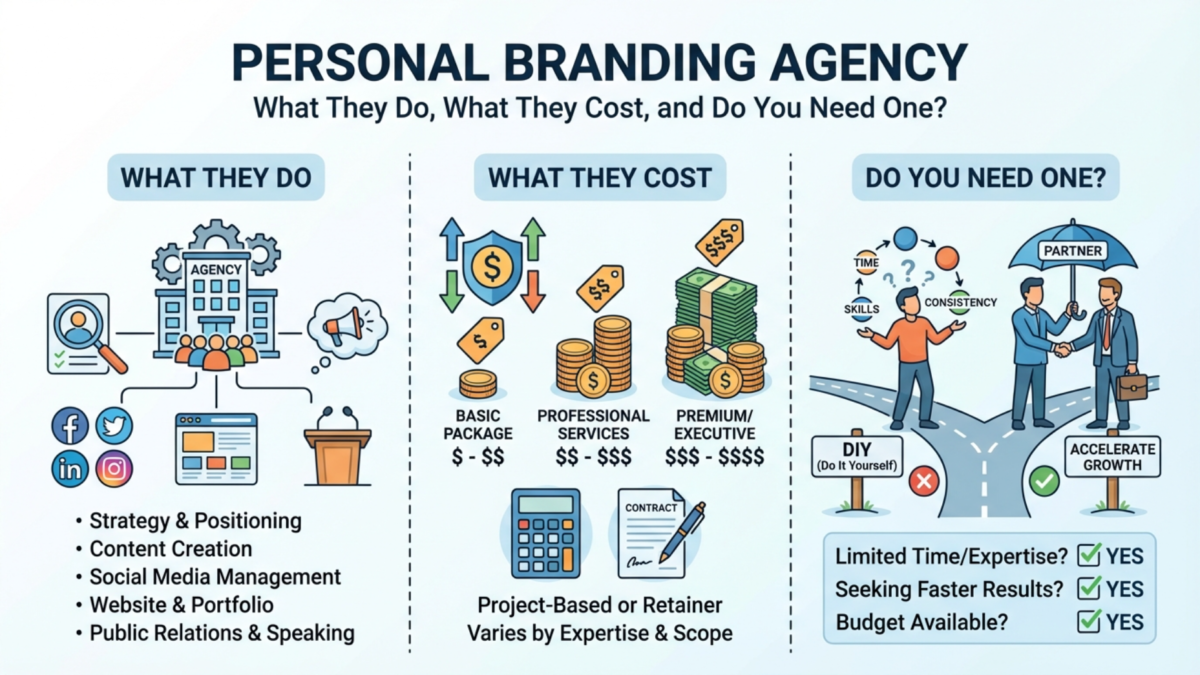
Personal Branding Agency: What They Do, What They Cost, and Do You Need One?
A personal branding agency is a firm that builds, manages, and grows the professional visibility of individuals rather than companies. The service category has expanded considerably over the past decade as senior professionals — executives, consultants, subject matter experts — have recognized that professional reputation now requires active, structured management rather than passive accumulation.
The market for personal branding agencies — a category Forbes has tracked extensively — ranges from boutique consultancies focused on specific industries or platforms to full-service firms handling everything from LinkedIn strategy to media placement to book publishing. Understanding what they actually do, what they cost, and whether the model makes sense for your situation requires cutting through significant noise in a category that is not always transparent about either its methods or its pricing.
What Does a Personal Branding Agency Do?
A personal branding agency helps clients define their professional positioning and makes that positioning visible across the platforms and surfaces that matter to their target audience. The scope of services varies substantially between agencies, but the core work typically falls into several categories:
Positioning and strategy. Defining who the client is positioning themselves as, for what audience, and why that positioning is credible and distinctive. This is the diagnostic and strategic layer — without it, the execution work lacks direction. Agencies that skip this phase and go straight to content production are essentially building infrastructure on undefined foundations.
LinkedIn profile optimization and strategy. For most professional personal brand builds, LinkedIn is the primary platform. Agency work here covers profile architecture, keyword strategy, content strategy, and engagement framework. Some agencies also manage posting on behalf of the client using ghostwriting and approval workflows.
Content creation and ghostwriting. A significant portion of personal branding agency work involves creating the content — articles, LinkedIn posts, thought leadership pieces, social media content — that makes a personal brand visible and substantiates its claims. For senior executives and business leaders with limited time, this is often the primary value delivered.
Digital presence architecture. Personal website development and optimization, speaker profile creation, professional bio writing, and optimization of presence across media that appear in search results for the client’s name. This layer addresses discoverability — ensuring that when someone Googles a client, what they find is coherent, authoritative, and aligned with the intended personal brand.
Media and PR placement. Higher-end personal branding agencies include earned media as part of their service — securing podcast appearances, article bylines in industry publications, speaking engagements, and press mentions. This is the tier that most directly accelerates authority signals and is also the most difficult to deliver consistently.
Thought leadership strategy and execution. Developing the specific points of view, frameworks, and research-backed perspectives that make a client recognizable as a credible voice on defined topics. Thought leadership as a practice is distinct from content production — it requires intellectual positioning, not just publishing frequency.
How Much Does a Personal Branding Agency Cost?
Personal branding agency pricing varies more widely than almost any other professional service category, primarily because the service scope and quality range is enormous.
Entry-level / LinkedIn-focused packages typically range from $1,000 to $3,000 per month. These usually include LinkedIn profile optimization, a monthly content calendar, and basic posting services — often with limited strategy and significant template reliance.
Mid-range full-service packages typically range from $3,000 to $8,000 per month. These include deeper positioning work, higher-quality ghostwriting, personal website development, and more structured thought leadership strategy. This tier represents the majority of serious personal branding investment for senior professionals.
High-end executive branding programs from specialized agencies — particularly those with strong media placement capabilities and experience working with C-suite executives at major organizations — range from $8,000 to $25,000+ per month, with some retaining on a project basis rather than a monthly model.
Project-based work such as a LinkedIn profile overhaul, personal website build, or brand strategy engagement typically ranges from $2,500 to $15,000 depending on scope and agency positioning.
Price is a rough proxy for quality but not a reliable one. The personal branding agency market has limited barriers to entry, and pricing reflects positioning strategy as much as service quality. Some of the most effective work in this space comes from boutique consultancies and individual strategists who charge less than major agencies while delivering more precisely calibrated strategy.
What Does a Personal Branding Agency Charge For That You Can Do Yourself?
An honest answer to this question matters, because not every component of personal brand development requires agency involvement.
Profile optimization, basic content strategy, and consistent LinkedIn publishing are learnable skills with significant free and low-cost educational resources available. A professional willing to invest 3-5 hours per week in learning and executing a personal brand strategy can accomplish meaningfully with self-directed effort — particularly in the early stages of brand building.
The categories where agency partnership typically delivers disproportionate value are positioning strategy (which requires outside perspective to do well), high-volume content production (which requires more time than most senior professionals have), and media placement (which requires existing relationships and industry knowledge that cannot be replicated quickly).
The decision to engage a personal branding agency is most clearly justified when time is genuinely scarce, when the professional context demands visible authority quickly, or when previous self-directed efforts have stalled. Understanding what is personal branding as a framework helps clarify which components are strategic (where outside help often accelerates results) versus executional (where consistency and commitment are more important than specialized knowledge).
What Is the 3-7-27 Rule of Branding?
The 3-7-27 rule describes the impression depth required for different levels of brand recognition. Three impressions for initial recognition, seven to remember the brand, twenty-seven before genuine trust develops.
For personal branding, this principle has a specific implication for how to evaluate agency work. An agency that promises rapid results — significant personal brand visibility within 30 to 60 days — is either working at the very surface level (profile optimization, which can show immediate search ranking improvements) or overpromising on the deeper recognition work that by its nature requires extended time. The trust layer that creates real professional opportunity takes months of consistent, substantive presence to accumulate. Any agency or strategy that suggests otherwise is not accounting for how authority actually builds.
What Are the Signs of a Strong Personal Branding Agency?
A personal branding agency worth engaging will demonstrate several characteristics that distinguish it from the majority of the market:
They lead with strategy before execution. The first significant deliverable should be a positioning document or brand architecture — not a content calendar. Agencies that immediately begin producing social media content without a defined positioning foundation are executing before understanding.
They are transparent about what they can and cannot measure. Personal brand authority is partly quantifiable (LinkedIn follower growth, profile view increases, content engagement rates, search ranking for name keywords) and partly qualitative (perception changes in target audiences, inbound opportunity quality). An agency that promises only quantitative metrics may be optimizing for the wrong things. One that promises only qualitative impact without any measurable indicators is difficult to hold accountable.
Their own brand team demonstrates the kind of authority they promise to build for clients. An agency that cannot demonstrate effective personal branding for its own leadership team is a meaningful signal. The service requires genuine expertise, and that expertise should be visible.
They have a defined methodology. The difference between a personal branding agency and a social media management service is the strategic layer — the process of defining positioning, identifying authority signals, and constructing a systematic approach to visibility. A genuine personal branding agency should be able to articulate that methodology with specificity, not just describe deliverables.
Do You Actually Need a Personal Branding Agency?
The honest answer depends on the professional’s specific situation.
A personal branding agency makes clear sense when: you are a senior executive or established expert with high-value time, you are navigating a significant career or business transition where rapid visibility matters, or you have tried to build your personal brand independently and reached a ceiling in terms of either content quality or strategic clarity.
A personal branding agency is not necessary when: you are early in your career, your primary goal is career advancement within an existing organization (where internal relationships matter more than external visibility), or your timeline allows for gradual, self-directed brand development.
For many mid-senior professionals, the most effective approach is neither full agency engagement nor entirely independent work. A consulting engagement to develop the positioning strategy and architecture, followed by independent execution with periodic guidance, often produces better long-term results than an ongoing agency retainer — because it builds the professional’s own understanding of how their brand works, rather than creating dependency on an external team.
If you are a professional whose expertise deserves more visibility and you are weighing the right approach, I’d welcome the conversation on LinkedIn. The approach that fits your situation depends on your specific context, goals, and timeline — and those variables matter more than any generic recommendation.